Thursday, 20 December 2012

Same Sex Marriage

There has been a long thread of e-mails between members of our local Conservative Party on the the subject of Same Sex Marriage and I feel it appropriate to publish a couple of my replies to a young lady who can see no problem with it.


Hi Mary

I know you said you wouldn’t read anything more in this thread – but you must understand that we don’t hate gays.  As Christians we are commanded to love everyone.  What we are supposed to do, however, is to hate the sin, not the sinner.

I would implore you to follow this link which will put it into perspective.

 I do understand, of course, that you aren’t a Christian, so you may not understand our feelings.  What we object to is that Cameron is proposing to change the law for the sake of just 5% of the population.  And yes, it will affect us very much.  Despite his protestations to the contrary, our churches will be compelled by the European Court of Human rights to solemnise same sex marriage.  For my particular church it will mean having to close our temples where we have been sealing husbands and wives together for time and eternity, as we believe that marriage between a man and woman should endure beyond the grave.

To us, it is vitally important to preserve this.  What right has Cameron to deny this to us?

Also, it will diminish marriage in the Biblical context as it is between a man and a woman.

Regards

Michael

Mary

Thank you for your reply.   It would appear that you haven’t followed the link I gave you which would have saved you from writing so much about our perceived beliefs.

Our church would not have to close per se; we just wouldn't solemnise any marriages at all in our chapels, but our two temples  in the UK would as European law would eventually require us to open them to people unable to adhere to the Christian law of chastity, which is that there should be no sexual intercourse except between a husband and a wife.  The temple is a place for members of the Church who have demonstrated themselves ready to make certain covenants with God, which is known as the Endowment, and for spouses to be sealed for time and eternity.  I didn’t explain before as you aren’t a Christian and I wouldn’t have expected you to have to read a long explanation about what we believe.  

Suffice to say that temples are where worthy members receive ordinances for our exaltation in the celestial kingdom, and the Lord has said that they are defiled if unworthy people are allowed to enter.

Please read the link I provided as it will explain our attitude to homosexuals.  In a nutshell, we love all God’s children, which is why we encourage them to obey the commandments so they can eventually return to His presence.  I explained the Christian law of Chastity above and homosexuals are just as bound to keep it as heterosexuals, so they are welcome as long as they refrain from sex outside marriage (ie the union of a man and woman).  

We are only obeying God.  What Cameron is doing is that through ignorance he is compelling Christians to relinquish their beliefs for just 5% of the population – and that is what we resent.  Homosexuals already have civil partnerships; they don’t need anything else.  The Blair government discriminated against Christians and Cameron is continuing to do so, but in an even worse way – and this is why Andrew Ross has resigned and nearly did so.  As I said before, virtually all my friends have now refused to vote Conservative and are beginning to support UKIP.

The Conservative party is run by its grassroots supporters, of whom the vast majority are people like myself, admittedly somewhat long in the tooth, but we are the backbone of the party and resent being side-lined for the sake of “modernisation.”  Our values always used to be espoused by the Party but no longer. 

I repeat: we do NOT hate gays.  We believe in live and let live, but we are now being discriminated against for the sake of just 5% of the population.  I hope you understand.

Michael


Tuesday, 18 December 2012

The True Church???????????????????

An Effort to Define the True Church That Fails in Many Ways

I have added my comments during the article and following:

Someone posted this article to Facebook and asked for my comments, so here they are in bold and underlined:


THE TRUE CHURCH
By Bishop J. C. Ryle
(1816-1900) Liverpool, England
I want you to belong to the one true Church: to the Church outside of which there is no salvation. I do not ask where you go on a Sunday; I only ask, "Do you belong to the one true Church?" Where is this one true Church? What is this one true Church like? What are the marks by which this one true Church may be known? You may well ask such questions. Give me your attention, and I will provide you with some answers.
1. The one true Church IS COMPOSED OF ALL BELIEVERS IN THE LORD JESUS. It is made up of all God's elect — of all converted men and women — of all true Christians. In whomsoever we can discern the election of God the Father, the sprinkling of the blood of God the Son, the sanctifying work of God the Spirit,(how?) in that person we see a member of Christ's true Church.
2. It is a Church OF WHICH ALL THE MEMBERS HAVE THE SAME MARKS. They are all born again of the Spirit; they all possess "repentance towards God, faith towards our Lord Jesus Christ," and holiness of life and conversation. They all hate sin, and they all love Christ. (They worship differently, and after various fashions; some worship with a form of prayer, and some with none; some worship kneeling, and some standing; but they all worship with one heart.) They are all led by one Spirit; they all build upon one foundation; they all draw their religion from one single book — that is the Bible. They are all joined to one great centre — that is Jesus Christ. They all even now can say with one heart, "Hallelujah;" and they can all respond with one heart and voice, Amen and Amen. (Some don’t pray yet they are the elect!!)
3. It is a Church WHICH IS DEPENDENT UPON NO MINISTERS UPON EARTH, however much it values those who preach the gospel to its members. The life of its members does not hang upon Church-membership, or baptism, or the Lord's Supper — although they highly value these things when they are to be had. But it has only one Great Head — one Shepherd, one chief Bishop — and that is Jesus Christ. He alone, By His Spirit, admits the members of this Church, though ministers may show the door. Till He opens the door no man on earth can open it — neither bishops, nor presbyters, nor convocations, nor synods. Once let a man repent and believe the gospel, and that moment he becomes a member of this Church. Like the penitent thief, he may have no opportunity of being baptised; but he has that which is far better than any water-baptism — the baptism of the Spirit. He may not be able to receive the bread and wine in the Lord's Supper;but he eats Christ's body and drinks Christ's blood by faith every day he lives, and no minister on earth can prevent him. He may be ex-communicated by ordained men, and cut off from the outward ordinances of the professing Church; but all the ordained men in the world cannot shut him out of the true Church. It is a Church whose existence does not depend on forms, ceremonies, cathedrals, churches, chapels, pulpits, fonts, vestments, organs, endowments, money, kings, governments, magistrates or any act of favour whatsoever from the hand of man. It has often lived on and continued when all these things have been taken from it. It has often been driven into the wilderness, or into dens and caves of the earth, by those who ought to have been its friends. Its existence depends on nothing but the presence of Christ and His Spirit; and they being ever with it, the Church cannot die.   (No authority needed, no baptism)
(Let’s take this further.  Bishop Ryle has misunderstood the meaning of “paradise” which means: Paradise. A Persian word meaning a garden. It is not found in the O.T. In the N.T. it occurs in Luke 23:43, 2 Cor. 12:4, and Rev. 2:7. Paradise is that part of the spirit world in which the righteous spirits who have departed from this life await the resurrection of the body. It is a condition of happiness and peace. However, the scriptures are not always consistent in the use of the word, especially in the Bible. For example, when Jesus purportedly said to the thief on the cross, “To day shalt thou be with me in paradise” (Luke 23:43), the Bible rendering is incorrect. The statement would more accurately read, “Today shalt thou be with me in the world of spirits” since the thief was not ready for paradise. Possibly 2 Cor. 12:4 should also not use paradise in the sense of meaning the spirit world, as much as meaning the celestial kingdom. The “paradisiacal glory” refers to the glorified millennial state of the earth rather than the spirit world.
He then says that priesthood is unnecessary.  However, we must have priesthood authority to act in the name of God when performing the sacred ordinances of the gospel, such as baptism, confirmation and administration of the sacrament, ordinances that Bishop Ryle says are unnecessary.  If a man doesn’t have the priesthood, even though he may be sincere, the Lord will not recognise ordinances he performs – Matthew 7:  
21 ¶Not every one that asaith unto me, bLord, Lord, shall enter into the kingdom of heaven; but he that cdoeth the dwill of my Father which is in heaven.e
 22 Many will say to me in that day, Lord, Lord, have we notaprophesied in thy name? and in thy bname have cast out devils? and in thy name done many wonderful works?
 23 And then will I profess unto them, I never aknew you: bdepartfrom me, ye that work ciniquity.

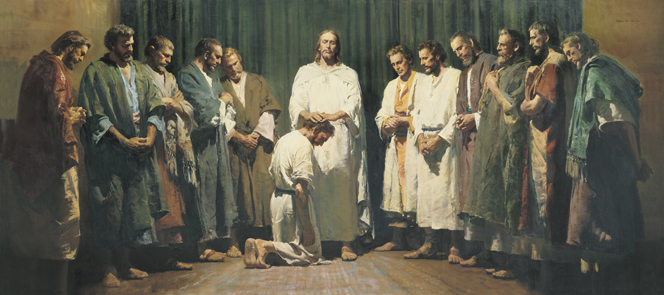
These important ordinances must be performed on the earth by men holding the priesthood.  When Christ was in his mortal ministry He chose His apostles so they could lead his church, and gave them the power and authority to act in His name.
Mark 3 13 And he goeth up into a mountain, and calleth unto him whom he awould: and they came unto him.
 14 And he aordained twelve, that they should be with him, and that he might send them forth to bpreach,
 15 And to have apower to heal bsicknesses, and to cast out cdevils:
John 15: 16 Ye have not chosen me, but I have achosen you, and bordainedyou, that ye should go and bring forth cfruit, and that your fruit should remain: that whatsoever ye shall ask of the Father in mydname, he may give it you.
Hebrews 5:And no man taketh this honour unto himself, but he that isbcalled of God, as was cAaron.
4. This is the Church TO WHICH THE SCRIPTURAL TITLES OF PRESENT HONOUR AND PRIVILEGE, AND THE PROMISES OF FUTURE GLORY ESPECIALLY BELONG; this is the Body of Christ; this is the flock of Christ; this is the household of faith and the family of God; this is God's building, God's foundation, and the temple of the Holy Ghost. This is the Church of the first-born, whose names are written in heaven; this is the royal priesthood, the chosen generation, the peculiar people, the purchased possession, the habitation of God, the light of the world, the salt and the wheat of the earth; this is the "Holy Catholic Church" of the Apostles' Creed; this is the "One Catholic and Apostolic Church" of the Nicene Creed; this is that Church to which the Lord Jesus promises "the gates of hell shall not prevail against it," and to which He says, "I am with you always, even unto the end of the world"(Matt.16:18; 28:2). (But it’s not a church – it’s constructed by man, having no authority as Bishop Rykle has deemed it unnecessary).
5. This is the only Church WHICH POSSESSES TRUE UNITY. Its members are entirely agreed on all the weightier matters of religion, for they are all taught by one Spirit. About God, and Christ, and the Spirit, and sin, and their own hearts, and faith, and repentance, and necessity of holiness, and the value of the Bible, and the importance of prayer, and the resurrection, and judgment to come — about all these points they are of one mind. Take three or four of them, strangers to one another, from the remotest corners of the earth; examine them separately on these points: you will find them all one judgment. (How do they agree since there is no organisation?  And what about the many doctrines which have led to different churches being established?  Are people taught by one spirit, especially those who don’t pray?  The Church of England is a good example as they are unable to agree about very much.  They are directed by no spirit at all.)
6. This is the only Church WHICH POSSESSES TRUE SANCTITY. Its members are all holy. They are not merely holy by profession, holy in name, and holy in the judgment of charity; they are all holy in act, and deed, and reality, and life, and truth. They are all more or less conformed to the image of Jesus Christ. No unholy man belongs to this Church. (But who determines this, since  there is no priesthood and no baptism?)
7. This is the only Church WHICH IS TRULY CATHOLIC. It is not the Church of any one nation or people; its members are to be found in every part of the world where the gospel is received and believed. It is not confined within the limits of any one country, or pent up within the pale of any particular forms of outward government. In it there is no difference between Jew and Greek, black man and white, Episcopalian and Presbyterian - but faith in Christ is all. Its members will be gathered from north, and south, and east, and west, and will be of every name and tongue — but all one in Jesus Christ.  (Is all they have to do to say they believe?  And if they are gathered from all over the world why are there so few of them? )
8. This is the only Church WHICH IS TRULY APOSTOLIC. It is built on the foundation laid by the Apostles, and holds the doctrines which they preached. The two grand objects at which its members aim are apostolic faith and apostolic practice; and they consider the man who talks of following the Apostles without possessing these two things to be no better than sounding brass and tinkling cymbal.  (I assume Bishop Ryle means Apostolic in the sense that the church follows the direction of the apostles, but It can’t be as there is no authority, so there is no-one to determine this. Jesus bestowed the keys of authority on His apostles but this was lost through apostasy.  Therefore a Restoration was necessary.  ).
9. This is the only Church WHICH IS CERTAIN TO ENDURE UNTO THE END. Nothing can altogether overthrow and destroy it. Its members may be persecuted, oppressed, imprisoned, beaten, beheaded, burned; but the true Church is never altogether extinguished; it rises again from its afflictions; it lives on through fire and water. When crushed in one land it springs up in another. The Pharaohs, the Herods, the Neros, the Bloody Marys, have laboured in vain to put down this Church; they slay their thousands, and then pass away and go to their own place. The true Church outlives them all, and sees them buried each in his turn. It is an anvil that has broken many a hammer in this world, and will break many a hammer still; it is a bush which is often burning, and yet it's not consumed.  (Of course it can survive – even through total apostasy – as there is no substance to it.  Anybody can start a church and there it is re-established.  They just say they believe in Christ and have repented and, hey presto, they are members.  In fact, it’s not one church but many, with lots of different beliefs, the only common one being a faith in Jesus Christ.  Matt 7: 21 ¶Not every one that asaith unto me, bLord, Lord, shall enter into the kingdom of heaven; but he that cdoeth the dwill of my Father which is in heaven.e)
10. This is the only Church OF WHICH NO ONE MEMBER CAN PERISH. Once enrolled in the lists of this Church, sinners are safe for eternity; they are never cast away. The election of God the Father, the continual intercession of God the Son, the daily renewing and sanctifying power of God the Holy Ghost, surround and fence them in like a garden enclosed. Not one bone of Christ's mystical Body shall ever be broken; not one lamb of Christ's flock shall ever be plucked out of His hand.  (Predestination – how convenient.  That means you can do exactly as you like.  Now wonder it’s popular!  He’s already stated that baptism isn’t necessary to be “enrolled” into this ephemeral “church”, so all people have to do is to say they have repented and that they believe – AND THEY ARE AUTOMATICALLY SAVED!!!!!!!!!!!!!!!!!!!!!!!)
11. This is the Church WHICH DOES THE WORK OF CHRIST UPON EARTH. Its members are a little flock, and few in numbers, compared with the children of the world; one or two here, and two or three there — a few in this place and few in that. But these are they who shake the universe; these are they who change the fortunes of kingdoms by their prayers; these are they who are the active workers for spreading the knowledge of pure religion and undefiled; these are the life-blood of a country, the shield, the defence, the stay, and the support of any nation to which they belong.  (This seems very contradictory to me.  As it’s so easy to join – no baptism, no authority and you can do as you like – there must be many members).
12. This is the Church WHICH SHALL BE TRULY GLORIOUS AT THE END. When all earthly glory is passed away then shall this Church be presented without spot before God the Father's throne. Thrones, principalities, and powers upon earth shall come to nothing; dignities, and offices, and endowments shall all pass away; but the Church of the first-born shall shine as the stars at the last, and be presented with joy before the Father's throne, in the day of Christ's appearing. When the Lord's jewels are made up, and manifestation of the sons of God takes place, Episcopacy, and Presbyterianism, and Congregationalism will not be mentioned; one Church only will be named, and that is the Church of the elect.  (But the members of this “church” will have dipped out for eternity and will not be the royal priesthood who inherit thrones, principalities and powers. See Rev 3:1 21 To him that aovercometh will I grant to bsit with me in mycthrone, even as I also overcame, and am set down with my Father in his throne.)
13. Reader, THIS IS THE TRUE CHURCH TO WHICH A MAN MUST BELONG, IF HE WOULD BE SAVED. Till you belong to this, you are nothing better than a lost soul. You may have the form, the husk, the skin, and the shell of religion, but you have not got the substance and the life. Yes, you may have countless outward privileges; you may enjoy great light, and knowledge — but if you do not belong to the Body of Christ, your light and knowledge and privileges will not save your soul. Alas, for the ignorance that prevails on this point! Men fancy if they join this church or that church, and become communicants, and go through certain forms, that all must be right in their souls. It is an utter delusion, it is a gross mistake. All were not Israel who were called Israel, and all are not members of Christ's Body who profess themselves Christian. TAKE NOTICE; you may be a staunch Episcopalian, or Presbyterian, or Independent, or Baptist, or Wesleyan, or Plymouth Brother — and yet not belong to the true Church. And if you do not, it will be better at last if you had never been born.

I am surprised that someone who served a mission for the Church of Latter-day Saints could have been taken in by this.  What Bishop Ryle has done is to take – as an Anglican – the 39 Articles of Religion and build his doctrine around them.   He totally ignores what Jesus taught Nicodemus in John 3:  
Jesus answered and said unto him, Verily, verily, I say unto thee, Except a man be born again, he cannot see the kingdom of God.
 Nicodemus saith unto him, How can a man be born when he is old? can he enter the second time into his mother’s womb, and be born?
 Jesus answered, Verily, verily, I say unto thee, Except a man be born of water and of the Spirit, he cannot enter into the kingdom of God.

We inevitably return to the meaning of being born again.  Ben says he was born again as a result of reading Bishop Ryle’s article, but one major thing it DOES NOT do is to give you the chance to be born again.  To be able to receive the blessing of eternal life – not to confused with immortality – we need to be “spiritually minded” and conquer our unrighteous desires. We need to change.  More accurately, we need to be changed, or converted, through the power of the Saviour’s Atonement and through the power of the Holy Ghost. 
This is conversion, which involves a change in behaviour, but it goes beyond behaviour; it is a change to our very nature.  It is such a significant change that the Lord and His prophets refer to it as a rebirth, a change of heart and a baptism of fire.  The Lord said:
25 And the Lord said unto me: Marvel not that all mankind, yea, men and women, all nations, kindreds, tongues and people, must be aborn again; yea, bborn of God, cchanged from their carnal anddfallen state, to a state of righteousness, being redeemed of God, becoming his esons and daughters;
 26 And thus they become new creatures; and unless they do this, they can in anowise inherit the kingdom of God.

These are the characteristics of those who have been converted:
  • They desire to do good.
  • They do not rebel against the Lord.
  • They share the gospel.
  • They are filled with love.
Conversion is a continual process:
Matthew 10:  22 And ye shall be ahated of all men bfor my cname’s sake: but he that dendureth to the end shall be saved.

So you are not just saved; you have to endure to the end.  And Jesus said baptism is essential – but evidently Bishop Ryle knows better than Jesus!!

Sunday, 18 November 2012

The Melchizedec Priesthood

In the Restored Church of  Jesus Christ of Latter-day Saints authority is held by the Melchizedec Priesthood, the highest and holiest priesthood, and is after the order of the Son of God.  All other authorities are appendages to this priesthood.  It is evident that the prophets of old held the priesthood,  but not the Aaronic Priesthood as this was for making sacrifices and held by the descendants of Aaron.  Joseph Smith said: "All the prophets held the Melchizedec Priesthood and were ordained by God himself," meaning Jehovah.  These persons so honoured held their authority by special dispensation, as the other priesthood order was the Levitical, as mentioned above.

When Christ came, he being a high priest forever after the order of Melchizedec, (Heb.2:17-18) the order held by the prophets was once again spread forth among the people:
16 Ye have not chosen me, but I have achosen you, and bordainedyou, that ye should go and bring forth cfruit, and that your fruit should remain: that whatsoever ye shall ask of the Father in mydname, he may give it you.  John 15:16
Ye also, as alively stones, are built up a bspiritual chouse, an holy priesthood, to offer up dspiritual esacrifices, acceptable to God by Jesus Christ.
But ye are a achosen generation, a broyal cpriesthood, an dholyenation, a fpeculiar people; that ye should shew forth the praises of him who hath called you out of gdarkness into his marvelloushlight:   1 Peter 2:5,9

So the Melchizedec Priesthood was restored, under apostolic direction a kingdom of priests being again found on the earth.  However, after the apostles had all died there was no one left holding the keys to authorise a person to be ordained to any priestly office, and in this manner the Lord took the priesthood  from the Earth. ( See Rev.12)


he Melchizedek Priesthood was first made known to Adam, and the patriarchs and prophets in every dispensation had this authority (D&C 84:6–17Teachings of the Prophet Joseph Smith, pp. 180–81). When the children of Israel failed to live up to the privileges and covenants of the Melchizedek Priesthood, the Lord took away the higher law and gave them a lesser priesthood and a lesser law. These were called the Aaronic Priesthood and the law of Moses. The Aaronic Priesthood is not a different priesthood; rather, it is the lesser portion of the priesthood, dealing with the introductory ordinances and the preparatory commandments (D&C 84:18–28). When Jesus came, he restored the Melchizedek Priesthood to the Jews and began to build up the Church among them. However, it was lost again by apostasy, and was taken from the earth.
The Melchizedek Priesthood was restored to the earth in these last days by the ministry of Peter, James, and John, who literally came to Joseph Smith and Oliver Cowdery in the spring of 1829 and conferred this power and authority upon them (D&C 27:12–13). Later, Moses, Elias, and Elijah gave them further keys by which these brethren could use the Melchizedek Priesthood in additional ways (D&C 110). The president of The Church of Jesus Christ of Latter-day Saints is the president of the high or Melchizedek Priesthood, and by virtue of this position, he holds all the keys that pertain to the kingdom of God on the earth. This office or calling is held by only one man at a time, and he is the only person on the earth at that time in whom all the powers and keys of the Melchizedek Priesthood are functional.

Wednesday, 14 November 2012

More Evidence for the Great Apostasy


The Great Apostasy as Seen by Eusebius


One of the most fascinating periods in history is the first part of the Christian era. Its importance to Latter-day Saints is perhaps surpassed only by our ignorance of it. Yet there were historians who wrote during those centuries, historians who plainly and tragically portrayed the fate of the church established by the Lord during his ministry. Eusebius, one of the earliest Christian historians, actually witnessed and wrote of the beginnings of the great apostasy that ultimately made necessary the restoration of the gospel.
Eusebius was born about A.D. 260, probably in Caesarea, a Mediterranean port west and a bit south of the Sea of Galilee. He distinguished himself as a scholar while young, was imprisoned for his religious views in 309 and again in 311, and in 314 was made Bishop of Caesarea. There he had access to a large library, founded by Pamphilus; in addition, there was available to him the library at Jerusalem. He was a thorough and accurate writer who nevertheless produced no fewer than forty-six works. He died in 339 or 340, two or three years after the death of the Emperor Constantine, whom he admired greatly and whom he had baptized. One of Eusebius’s major endeavors was the ten-volume Ecclesiastical History,probably written just prior to 326, in which he records the events in the church from the death of the apostles to the triumph of Constantine.
One of the distinguishing features of Mormonism is its concept of the relationship of ChristGod the Father, and this earth; for instance, our knowledge that the God of the Old Testament, Jehovah, the God of Israel, was in reality Jesus Christ. This knowledge was shared by Eusebius and has since been lost in the general confusion about the nature of the Trinity. He says:
“The Marshal and Fashioner of the universe gave up to Christ Himself, … His first-begotten, the making of subordinate beings, and discussed with Him the creation of man: ‘For God said, Let us make man in our image and likeness.’
“This saying is confirmed by another of the prophets, who in hymns deifies him thus:
‘He spoke, and they were begotten:
He commanded, and they were created.’
The Father and Maker he introduces as giving commands like a supreme ruler by an imperial fiat; the divine Word, who holds the second place to Him—none other than the One whom we proclaim—as subserving his Father’s behests.” 1
“But it is obvious that they knew God’s Christ Himself, since He appeared to Abraham, instructed Isaac, spoke to Israel, and conversed freely withMoses and the prophets who came later, as I have already shown. … Obviously we must regard the religion proclaimed in recent years to all nations through Christ’s teaching as none other than the first, most ancient, and most primitive of all religions, discovered by Abraham … [to whom] an oracle was announced … by God—Christ Himself, the Word of God—who showed Himself to him.” 2
This concept of Christ and of the eternity of the gospel is excitingly familiar and beautifully clear to the Latter-day Saint reader. However, one translator of Eusebius, an Anglican, summarizes current secular ignorance as he admits:
“Eusebius’s view that the O.T. theophanies were appearances of Christ (in human form though not yet born a man) seems impossible to us. But have we yet solved the problem of reconciling the stories of encounters between men and the Deity with St. John’s assertion that no man has ever seen God?” 3
In a passage that clearly demonstrates both his understanding of the nature of Christ and the process of apostasy that was beginning to enter into the church and that was destined to culminate in the loss of this precious knowledge, Eusebius writes:
“Beryllus, … Bishop of Bostra in Arabia, perverted the true doctrine of the Church and tried to bring in ideas alien to the Faith, actually asserting that our Savior and Lord did not pre-exist in His own form of being before He made His home among men, and had no divinity of His own but only the Father’s dwelling in Him.” 4
One of the offices in the priesthood that is misunderstood by almost as many Mormons as gentiles is the calling of the seventy. Whether Eusebius really understood their function is not clear. However, he occasionally refers to them, collectively and individually:
“There is evidence that Matthias, who took Judas’s place in the list of apostles, and the other man honoured like him in the drawing of lots, had both been called to be among the seventy. Thaddeus, again, is said to have been one of them. … In addition to the Seventy there were other disciples of the Saviour.” 5
Eusebius quotes a fascinating little story about the missionary work and healings performed by “Thaddeus, one of the Seventy” after the crucifixion of the Savior, indicating that the calling of seventy was a fixture in the most primitive church, and that the responsibilities of this office did not terminate with the first mission on which the Lord sent the seventies. (SeeLuke 10:1–12.)
Eusebius quotes Clement of Alexandria (about A.D. 150–215) in a passage where reference is made to the seventy:
“James the Righteous, John, and Peter were entrusted by the Lord after hisresurrection with the higher knowledge. They imparted it to the other apostles, and the other apostles to the Seventy, one of whom was Barnabas.” 6
As we look back across seventeen centuries, blessed with the hindsight that our position in time affords us, we are struck with the scores of references that Eusebius makes to apostasies and heresies within the church. One of the more pernicious was the teaching of the doctrine of celibacy:
“Clement [of Alexandria] … gives a list of those of the apostles who were married. This he does on account of those who condemn marriage. He says, ‘Will they also condemn the apostles? For Peter and Philip had children, and Philip gave his daughters to husbands. Indeed, Paul does not hesitate to address his wife in one of his letters. It was to facilitate his mission that he did not bring her around with him.’” 7
He quotes Clement again:
“We are told that when blessed Peter saw his wife led away to death he was glad that her call had come and that she was returning home, and spoke to her in the most encouraging and comforting tones, addressing her by name: ‘My dear, remember the Lord.’ Such was the marriage of the blessed, and their consummate feeling towards their dearest.” 8
Eusebius also quotes from Irenaeus (A.D. 130–200), Bishop of Lyon:
“… the people called Encratites preached against marriage, thereby rejecting the ancient plan of God and silently condemning the creator of male and female whose purpose was the begetting of human kind. … They also denied the salvation of the first man.
“This was introduced by them when a certain Tatian became the first to propound their blasphemy. He had been a disciple of Justin, and as long as he remained in his company he produced nothing of this kind; but after Justin’s martyrdom he apostatized from the Church. He grew exalted with the idea of becoming a teacher. He became puffed up, believing himself superior to the others. He fabricated his own brand of doctrine, telling tales of invisible eons, … and … he denounced marriage as corruption and fornication.” 9
This passage is most interesting, showing as it does not only that the early leaders strongly opposed the doctrine of celibacy, but also that deviation from the truth was beginning to spring up within the membership of the church.
Eusebius traces the development of apostasy in the Church from the very earliest days. Speaking of the first century, he says:
“… [Hegesippus (A.D. 100–180)] in describing the period [when the last contemporary of the Savior died] … adds that until then the Church remained a pure and untouched maiden. Those intent upon the corruption of the healthful rule of the Savior’s message lay low in murky darkness, if indeed such persons existed at all. But when the members of the sacred band of apostles had reached the end of life in different ways, and when there had disappeared that generation privileged to hear the wisdom of God in person, then did the organization of godless error take root through deceitful purveyors of falsehood. With none of the apostles still alive, they openly tried to counter the message of truth with the proclamation of a knowledge falsely named.” 10
“But with our greater freedom a change came over us. We yielded to pride and sloth. We yielded to mutual envy and abuse. We warred upon ourselves as occasion offered, and we used the weapons and the spears of words. Leaders fought with leaders and laity formed factions against laity. Unspeakable hypocrisy and dissimulation traveled to the farthest limits of evil.” 11
Finally, when, under the rule of Constantine, being a Christian was not only safe but also prudent, we find outsiders insinuating themselves into the church for reasons of personal ambition:
“There was also the unspeakable hypocrisy of men who crept into the Church and who took on the name and the character of Christians. Because of his benevolence and good nature, because his faith was real and his character true, [Constantine] put his trust in those who said they were Christians and who feigned the utmost affection for him.” 12
The writings of Eusebius portray graphically the condition of the church after the death of the apostles, written from a point in time where the doctrines were already beginning to be corrupted, when the true priesthood had already been lost. The tragic deaths of so many of the inspired leaders, the terrific influence of the pagan Constantine, and the story of apostasy after apostasy are all found in Ecclesiastical History.
In summation, I believe that Christ’s church was gradually lost and that the churches today do not teach the doctrine taught by the Master. The writings of Eusebius are but another testimony to the truth of these assertions.