Sunday, 18 November 2012

The Melchizedec Priesthood

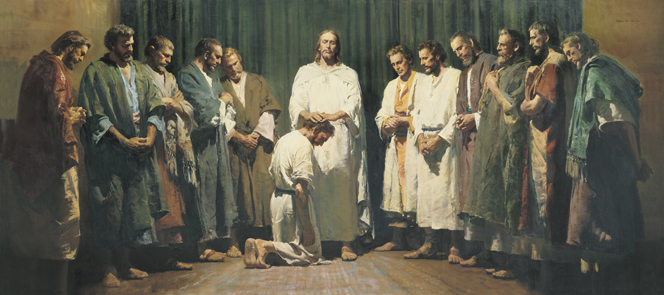
In the Restored Church of  Jesus Christ of Latter-day Saints authority is held by the Melchizedec Priesthood, the highest and holiest priesthood, and is after the order of the Son of God.  All other authorities are appendages to this priesthood.  It is evident that the prophets of old held the priesthood,  but not the Aaronic Priesthood as this was for making sacrifices and held by the descendants of Aaron.  Joseph Smith said: "All the prophets held the Melchizedec Priesthood and were ordained by God himself," meaning Jehovah.  These persons so honoured held their authority by special dispensation, as the other priesthood order was the Levitical, as mentioned above.

When Christ came, he being a high priest forever after the order of Melchizedec, (Heb.2:17-18) the order held by the prophets was once again spread forth among the people:
16 Ye have not chosen me, but I have achosen you, and bordainedyou, that ye should go and bring forth cfruit, and that your fruit should remain: that whatsoever ye shall ask of the Father in mydname, he may give it you.  John 15:16
Ye also, as alively stones, are built up a bspiritual chouse, an holy priesthood, to offer up dspiritual esacrifices, acceptable to God by Jesus Christ.
But ye are a achosen generation, a broyal cpriesthood, an dholyenation, a fpeculiar people; that ye should shew forth the praises of him who hath called you out of gdarkness into his marvelloushlight:   1 Peter 2:5,9

So the Melchizedec Priesthood was restored, under apostolic direction a kingdom of priests being again found on the earth.  However, after the apostles had all died there was no one left holding the keys to authorise a person to be ordained to any priestly office, and in this manner the Lord took the priesthood  from the Earth. ( See Rev.12)


he Melchizedek Priesthood was first made known to Adam, and the patriarchs and prophets in every dispensation had this authority (D&C 84:6–17Teachings of the Prophet Joseph Smith, pp. 180–81). When the children of Israel failed to live up to the privileges and covenants of the Melchizedek Priesthood, the Lord took away the higher law and gave them a lesser priesthood and a lesser law. These were called the Aaronic Priesthood and the law of Moses. The Aaronic Priesthood is not a different priesthood; rather, it is the lesser portion of the priesthood, dealing with the introductory ordinances and the preparatory commandments (D&C 84:18–28). When Jesus came, he restored the Melchizedek Priesthood to the Jews and began to build up the Church among them. However, it was lost again by apostasy, and was taken from the earth.
The Melchizedek Priesthood was restored to the earth in these last days by the ministry of Peter, James, and John, who literally came to Joseph Smith and Oliver Cowdery in the spring of 1829 and conferred this power and authority upon them (D&C 27:12–13). Later, Moses, Elias, and Elijah gave them further keys by which these brethren could use the Melchizedek Priesthood in additional ways (D&C 110). The president of The Church of Jesus Christ of Latter-day Saints is the president of the high or Melchizedek Priesthood, and by virtue of this position, he holds all the keys that pertain to the kingdom of God on the earth. This office or calling is held by only one man at a time, and he is the only person on the earth at that time in whom all the powers and keys of the Melchizedek Priesthood are functional.

Wednesday, 14 November 2012

More Evidence for the Great Apostasy


The Great Apostasy as Seen by Eusebius


One of the most fascinating periods in history is the first part of the Christian era. Its importance to Latter-day Saints is perhaps surpassed only by our ignorance of it. Yet there were historians who wrote during those centuries, historians who plainly and tragically portrayed the fate of the church established by the Lord during his ministry. Eusebius, one of the earliest Christian historians, actually witnessed and wrote of the beginnings of the great apostasy that ultimately made necessary the restoration of the gospel.
Eusebius was born about A.D. 260, probably in Caesarea, a Mediterranean port west and a bit south of the Sea of Galilee. He distinguished himself as a scholar while young, was imprisoned for his religious views in 309 and again in 311, and in 314 was made Bishop of Caesarea. There he had access to a large library, founded by Pamphilus; in addition, there was available to him the library at Jerusalem. He was a thorough and accurate writer who nevertheless produced no fewer than forty-six works. He died in 339 or 340, two or three years after the death of the Emperor Constantine, whom he admired greatly and whom he had baptized. One of Eusebius’s major endeavors was the ten-volume Ecclesiastical History,probably written just prior to 326, in which he records the events in the church from the death of the apostles to the triumph of Constantine.
One of the distinguishing features of Mormonism is its concept of the relationship of ChristGod the Father, and this earth; for instance, our knowledge that the God of the Old Testament, Jehovah, the God of Israel, was in reality Jesus Christ. This knowledge was shared by Eusebius and has since been lost in the general confusion about the nature of the Trinity. He says:
“The Marshal and Fashioner of the universe gave up to Christ Himself, … His first-begotten, the making of subordinate beings, and discussed with Him the creation of man: ‘For God said, Let us make man in our image and likeness.’
“This saying is confirmed by another of the prophets, who in hymns deifies him thus:
‘He spoke, and they were begotten:
He commanded, and they were created.’
The Father and Maker he introduces as giving commands like a supreme ruler by an imperial fiat; the divine Word, who holds the second place to Him—none other than the One whom we proclaim—as subserving his Father’s behests.” 1
“But it is obvious that they knew God’s Christ Himself, since He appeared to Abraham, instructed Isaac, spoke to Israel, and conversed freely withMoses and the prophets who came later, as I have already shown. … Obviously we must regard the religion proclaimed in recent years to all nations through Christ’s teaching as none other than the first, most ancient, and most primitive of all religions, discovered by Abraham … [to whom] an oracle was announced … by God—Christ Himself, the Word of God—who showed Himself to him.” 2
This concept of Christ and of the eternity of the gospel is excitingly familiar and beautifully clear to the Latter-day Saint reader. However, one translator of Eusebius, an Anglican, summarizes current secular ignorance as he admits:
“Eusebius’s view that the O.T. theophanies were appearances of Christ (in human form though not yet born a man) seems impossible to us. But have we yet solved the problem of reconciling the stories of encounters between men and the Deity with St. John’s assertion that no man has ever seen God?” 3
In a passage that clearly demonstrates both his understanding of the nature of Christ and the process of apostasy that was beginning to enter into the church and that was destined to culminate in the loss of this precious knowledge, Eusebius writes:
“Beryllus, … Bishop of Bostra in Arabia, perverted the true doctrine of the Church and tried to bring in ideas alien to the Faith, actually asserting that our Savior and Lord did not pre-exist in His own form of being before He made His home among men, and had no divinity of His own but only the Father’s dwelling in Him.” 4
One of the offices in the priesthood that is misunderstood by almost as many Mormons as gentiles is the calling of the seventy. Whether Eusebius really understood their function is not clear. However, he occasionally refers to them, collectively and individually:
“There is evidence that Matthias, who took Judas’s place in the list of apostles, and the other man honoured like him in the drawing of lots, had both been called to be among the seventy. Thaddeus, again, is said to have been one of them. … In addition to the Seventy there were other disciples of the Saviour.” 5
Eusebius quotes a fascinating little story about the missionary work and healings performed by “Thaddeus, one of the Seventy” after the crucifixion of the Savior, indicating that the calling of seventy was a fixture in the most primitive church, and that the responsibilities of this office did not terminate with the first mission on which the Lord sent the seventies. (SeeLuke 10:1–12.)
Eusebius quotes Clement of Alexandria (about A.D. 150–215) in a passage where reference is made to the seventy:
“James the Righteous, John, and Peter were entrusted by the Lord after hisresurrection with the higher knowledge. They imparted it to the other apostles, and the other apostles to the Seventy, one of whom was Barnabas.” 6
As we look back across seventeen centuries, blessed with the hindsight that our position in time affords us, we are struck with the scores of references that Eusebius makes to apostasies and heresies within the church. One of the more pernicious was the teaching of the doctrine of celibacy:
“Clement [of Alexandria] … gives a list of those of the apostles who were married. This he does on account of those who condemn marriage. He says, ‘Will they also condemn the apostles? For Peter and Philip had children, and Philip gave his daughters to husbands. Indeed, Paul does not hesitate to address his wife in one of his letters. It was to facilitate his mission that he did not bring her around with him.’” 7
He quotes Clement again:
“We are told that when blessed Peter saw his wife led away to death he was glad that her call had come and that she was returning home, and spoke to her in the most encouraging and comforting tones, addressing her by name: ‘My dear, remember the Lord.’ Such was the marriage of the blessed, and their consummate feeling towards their dearest.” 8
Eusebius also quotes from Irenaeus (A.D. 130–200), Bishop of Lyon:
“… the people called Encratites preached against marriage, thereby rejecting the ancient plan of God and silently condemning the creator of male and female whose purpose was the begetting of human kind. … They also denied the salvation of the first man.
“This was introduced by them when a certain Tatian became the first to propound their blasphemy. He had been a disciple of Justin, and as long as he remained in his company he produced nothing of this kind; but after Justin’s martyrdom he apostatized from the Church. He grew exalted with the idea of becoming a teacher. He became puffed up, believing himself superior to the others. He fabricated his own brand of doctrine, telling tales of invisible eons, … and … he denounced marriage as corruption and fornication.” 9
This passage is most interesting, showing as it does not only that the early leaders strongly opposed the doctrine of celibacy, but also that deviation from the truth was beginning to spring up within the membership of the church.
Eusebius traces the development of apostasy in the Church from the very earliest days. Speaking of the first century, he says:
“… [Hegesippus (A.D. 100–180)] in describing the period [when the last contemporary of the Savior died] … adds that until then the Church remained a pure and untouched maiden. Those intent upon the corruption of the healthful rule of the Savior’s message lay low in murky darkness, if indeed such persons existed at all. But when the members of the sacred band of apostles had reached the end of life in different ways, and when there had disappeared that generation privileged to hear the wisdom of God in person, then did the organization of godless error take root through deceitful purveyors of falsehood. With none of the apostles still alive, they openly tried to counter the message of truth with the proclamation of a knowledge falsely named.” 10
“But with our greater freedom a change came over us. We yielded to pride and sloth. We yielded to mutual envy and abuse. We warred upon ourselves as occasion offered, and we used the weapons and the spears of words. Leaders fought with leaders and laity formed factions against laity. Unspeakable hypocrisy and dissimulation traveled to the farthest limits of evil.” 11
Finally, when, under the rule of Constantine, being a Christian was not only safe but also prudent, we find outsiders insinuating themselves into the church for reasons of personal ambition:
“There was also the unspeakable hypocrisy of men who crept into the Church and who took on the name and the character of Christians. Because of his benevolence and good nature, because his faith was real and his character true, [Constantine] put his trust in those who said they were Christians and who feigned the utmost affection for him.” 12
The writings of Eusebius portray graphically the condition of the church after the death of the apostles, written from a point in time where the doctrines were already beginning to be corrupted, when the true priesthood had already been lost. The tragic deaths of so many of the inspired leaders, the terrific influence of the pagan Constantine, and the story of apostasy after apostasy are all found in Ecclesiastical History.
In summation, I believe that Christ’s church was gradually lost and that the churches today do not teach the doctrine taught by the Master. The writings of Eusebius are but another testimony to the truth of these assertions.
Daniel's Dream


Chapter 2
Nebuchadnezzar’s dream is revealed to Daniel—The king saw a great image, a stone cut from the mountain without hands destroyed the image, and the stone grew and filled the whole earth—The stone is the latter-day kingdom of God.
 And in the second year of the reign of Nebuchadnezzar Nebuchadnezzar dreamed adreams, wherewith his spirit wasbtroubled, and his sleep brake from him.
 Then the king commanded to call the amagicians, and the astrologers, and the sorcerers, and the Chaldeans, for to shew the king his dreams. So they came and stood before the king.
 And the king said unto them, I have dreamed a dream, and my spirit was troubled to know the dream.
 Then spake the Chaldeans to the king in aSyriack, O king, live for ever: tell thy servants the dream, and we will bshew the interpretation.
 The king answered and said to the Chaldeans, The thing is agonefrom me: if ye will not make known unto me the dream, with the interpretation thereof, ye shall be bcut in pieces, and your houses shall be made a dunghill.
 But if ye shew the dream, and the interpretation thereof, ye shall receive of me gifts and rewards and great honour: therefore shew me the dream, and the interpretation thereof.
 They answered again and said, Let the king tell his servants the dream, and we will shew the interpretation of it.
 The king answered and said, I know of certainty that ye would gain the time, because ye see the thing is gone from me.
 But if ye will not make known unto me the dream, there is butone decree for you: for ye have prepared lying and corrupt words to speak before me, atill the time be changed: therefore tell me the dream, and I shall know that ye can shew me the interpretation thereof.
 10 ¶The Chaldeans answered before the king, and said, There is not a man upon the earth that can shew the king’s matter: therefore there is no king, lord, nor ruler, that asked such things at any magician, or astrologer, or Chaldean.
 11 And it is a rare thing that the king requireth, and there is none other that can shew it before the king, except the agods, whose dwelling is not with flesh.
 12 For this cause the king was angry and very furious, and commanded to destroy all the wise men of Babylon.
 13 And the decree went forth that the wise men should be slain; and they sought Daniel and his fellows to be slain.
 14 ¶Then Daniel answered with counsel and wisdom to Arioch the captain of the king’s guard, which was gone forth to slay the wisemen of Babylon:
 15 He answered and said to Arioch the king’s captain, Why is the decree so ahasty from the king? Then Arioch made the thing known to Daniel.
 16 Then Daniel went in, and desired of the king that he would give him time, and that he would shew the king the interpretation.
 17 Then Daniel went to his house, and made the thing known toaHananiah, Mishael, and Azariah, his companions:
 18 That they would desire mercies of the God of heaven concerning this secret; that Daniel and his fellows should not perish with the rest of the wise men of Babylon.
 19 ¶Then was the asecret revealed unto Daniel in a night bvision. Then Daniel blessed the God of heaven.
 20 Daniel answered and said, Blessed be the name of God for ever and ever: for awisdom and might are his:
 21 And he changeth the atimes and the bseasons: he cremovethkings, and setteth up kings: he giveth dwisdom unto the wise, andeknowledge to them that know understanding:
 22 He arevealeth the deep and secret things: he bknoweth what isin the darkness, and the clight dwelleth with him.
 23 I thank thee, and praise thee, O thou God of my fathers, who hast given me wisdom and might, and hast made known unto me now what we desired of thee: for thou hast now made known unto us the king’s matter.
 24 ¶Therefore Daniel went in unto Arioch, whom the king had ordained to destroy the wise men of Babylon: he went and said thus unto him; Destroy not the wise men of Babylon: bring me in before the king, and I will shew unto the king the interpretation.
 25 Then Arioch brought in Daniel before the king in haste, and said thus unto him, I have found a man of the captives of Judah, that will make known unto the king the interpretation.
 26 The king answered and said to Daniel, whose aname wasBelteshazzar, Art thou able to make bknown unto me the dream which I have seen, and the interpretation thereof?
 27 Daniel answered in the presence of the king, and said, The secret which the king hath demanded cannot the wise men, theaastrologers, the magicians, the soothsayers, shew unto the king;
 28 But there is a God in heaven that arevealeth bsecrets, and maketh known to the king Nebuchadnezzar what shall be in the latter days. Thy cdream, and the visions of thy head upon thy bed, are these;
 29 As for thee, O king, thy thoughts came into thy mind upon thy bed, what should come to pass hereafter: and he that arevealethsecrets maketh known to thee what shall come to pass.
 30 But as for me, this secret is not revealed to me for anyawisdom that I have more than any living, but bfor their sakes that shall make known the interpretation to the king, and that thou mightest know the thoughts of thy heart.
 31 ¶Thou, O king, sawest, and behold a great aimage. This great image, whose brightness was excellent, stood before thee; andbthe form thereof was terrible.
 32 This image’s head was of fine gold, his breast and his arms of silver, his belly and his thighs of brass,
 33 His legs of iron, his feet part of iron and part of clay.
 34 Thou sawest till that a astone was cut out bwithout hands, which smote the image upon his feet that were of iron and clay, and brake them to pieces.
 35 Then was the iron, the clay, the brass, the silver, and the gold, broken to pieces together, and became like the chaff of the summer threshingfloors; and the wind carried them away, that noaplace was found for them: and the bstone that smote the image became a great mountain, and filled the whole earth.
 36 ¶This is the dream; and we will tell the interpretation thereof before the king.
 37 Thou, O king, art a king of kings: for the God of heaven hath given thee a akingdom, power, and strength, and glory.
 38 And wheresoever the children of men dwell, the beasts of the field and the fowls of the heaven hath he given into thine hand, and hath made thee ruler over them all. Thou art this ahead of gold.
 39 And after thee shall arise another akingdom inferior to thee, and another third kingdom of brass, which shall bear brule over all the earth.
 40 And the fourth akingdom shall be strong as iron: forasmuch as iron breaketh in pieces and subdueth all things: and as iron that breaketh all these, shall it break in pieces and bruise.
 41 And whereas thou sawest the feet and toes, part of potters’ clay, and part of iron, the kingdom shall be divided; but there shall be in it of the strength of the airon, forasmuch as thou sawest the iron mixed with miry clay.
 42 And as the toes of the feet were part of iron, and part of clay,so the kingdom shall be partly strong, and partly broken.
 43 And whereas thou sawest iron mixed with miry clay, they shall mingle themselves with the seed of men: but they shall not cleave one to another, even as iron is not mixed with clay.
 44 And in the adays of these bkings shall the God of heaven cset up a dkingdom, which shall never be edestroyed: and the fkingdomshall not be left to other people, but it shall gbreak in pieces andhconsume all these ikingdoms, and it shall stand for ever.
 45 Forasmuch as thou sawest that the astone was cut out of the mountain without hands, and that it brake in pieces the iron, the brass, the clay, the silver, and the gold; the great God hath madebknown to the king what shall come to pass hereafter: and the dream is certain, and the interpretation thereof sure.
 46 ¶Then the king Nebuchadnezzar fell upon his face, andaworshipped Daniel, and commanded that they should offer an oblation and sweet odours unto him.
 47 The king answered unto Daniel, and said, Of a truth it is, that your aGod is a bGod of gods, and a cLord of kings, and a revealer of secrets, seeing thou couldest reveal this secret.
 48 Then the king made Daniel a agreat man, and gave him many great gifts, and made him ruler over the whole province of Babylon, and chief of the governors over all the wise men of Babylon.
 49 Then Daniel requested of the king, and he aset Shadrach, Meshach, and Abed-nego, over the affairs of the province of Babylon: but Daniel bsat in the gate of the king.
President Rudger Clawson elaborated on Daniel’s interpretation of Nebuchadnezzar’s dream: “The … world of today is witness of the fact that the very things which the great image stood for have occurred so far as time has gone. History certifies to the fact that King Nebuchadnezzar was the head of gold. The Medes and Persians, an inferior kingdom to Babylon, were the arms and breast of silver. The Macedonian kingdom, under Alexander the Great, was the belly and thighs of brass; and the Roman kingdom under the Caesars was the legs of iron. For mark you, later on the kingdom, or empire of Rome, was divided. The head of the government in one division was at Rome and the head of the government in the other division was at Constantinople. So these two great divisions represented the legs of iron. Finally, the Roman empire was broken up into smaller kingdoms, represented by the feet and toes of iron and clay.” (In Conference Report, Apr. 1930, p. 32).
Elder Orson Pratt, in explaining why the toes were shown as being partly iron and partly clay, said that “the feet and toes were governments more modern to grow out of the iron kingdom [Roman Empire], after it should lose its strength. These are represented by the ten toes or ten kingdoms which should be partly strong and partly broken. They should not have the strength of the legs of iron, but they should be mixed with miry clay, indicating both strength and weakness.” (In Journal of Discourses,18:337.)
President Spencer W. Kimball further clarified the prophecy with the following explanation:
“Rome would be replaced by a group of nations of Europe represented by the toes of the image.
“With the history of the world delineated in brief, now came the real revelation. Daniel said:
“‘And in the days of these kings [that is, the group of European nations] shall the God of heaven set up a kingdom, which shall never be destroyed …
“This is a revelation concerning the history of the world, when one world power would supersede another until there would be numerous smaller kingdoms to share the control of the earth.
“And it was in the days of these kings that power would not be given to men, but the God of heaven would set up a kingdom—the kingdom of God upon the earth, which should never be destroyed nor left to other people.
“The Church of Jesus Christ of Latter-day Saints was restored in 1830 after numerous revelations from the divine source; and this is the kingdom, set up by the God of heaven, that would never be destroyed nor superseded, and the stone cut out of the mountain without hands that would become a great mountain and would fill the whole earth.” (In Conference Report, Apr. 1976, p. 10.)
(28-14) Daniel 2:44–45. How Is It That the Kingdom Set Up by God Will Consume the Other Kingdoms?
Section 65 of the Doctrine and Covenants tells of the fulfillment of the rest of Daniel’s prophecy. The Prophet Joseph Smith prayed that the ecclesiastical kingdom of God, which was established on the earth in his day, might roll forth that the future kingdom of heaven might come.
“During the millennium the kingdom of God will continue on earth, but in that day it will be both an ecclesiastical and a political kingdom. That is, the Church (which is the kingdom) will have the rule and government of the world given to it.” (Bruce R. McConkie, Mormon Doctrine, p. 416.)
That millennial kingdom can also be properly referred to as the kingdom of heaven, as Joseph Smith did in his inspired prayer recorded in Doctrine and Covenants 65. The establishment of that kingdom is what the Lord taught the Saints to pray for in the Lord’s Prayer when He said, “Thy kingdom come” (Matthew 6:10; see also Joseph Fielding Smith, Doctrines of Salvation, 1:230). The coming forth of the kingdom on the earth is what Daniel saw when the stone rolled forth and smote the image, eventually filling the whole earth.
President Brigham Young taught: “The Lord God Almighty has set up a kingdom that will sway the sceptre of power and authority over all the kingdoms of the world, and will never be destroyed, it is the kingdom that Daniel saw and wrote of. It may be considered treason to say that the kingdom which that Prophet foretold is actually set up; that we cannot help, but we know it is so, and call upon the nations to believe our testimony. The kingdom will continue to increase, to grow, to spread and prosper more and more. Every time its enemies undertake to overthrow it, it will become more extensive and powerful; instead of its decreasing, it will continue to increase, it will spread the more, become more wonderful and conspicuous to the nations, until it fills the whole earth.” (In Journal of Discourses, 1:202–3.)
(28-15) Daniel 2:49. Daniel Prospered Because of His Righteousness
President Spencer W. Kimball summarized the qualities that Daniel possessed and the blessings his obedience to God brought him: “The gospel was Daniel’s life. … In the king’s court, he could be little criticized, but even for a ruler he would not drink the king’s wine nor gorge himself with meat and rich foods. His moderation and his purity of faith brought him health and wisdom and knowledge and skill and understanding, and his faith linked him closely to his Father in heaven, and revelations came to him as often as required. His revealing of the dreams of the king and the interpretations thereof brought him honor and acclaim and gifts and high position such as many men would sell their souls to get.” (In Conference Report, Mexico and Central America Area Conference 1972, p. 31.)
dream interpreted

(28-16) Daniel 3:1–18. Three Hebrews Who Were True to God in Spite of Threats and Pressure
Daniel did not stand alone as an exemplary young man. His three companions demonstrated the same unswerving loyalty and devotion to God. Of them Elder Spencer W. Kimball said: “We remind ourselves of the integrity of the three Hebrews, Shadrach, Meshach, and Abednego, who like Daniel defied men and rulers, to be true to themselves and to keep faith with their faith. They were required by decree of the emperor to kneel down and worship a monumental image of gold which the king had set up. In the face of losing caste, of losing position, of angering the king, they faced the fiery furnace rather than to fail and deny their God. The cunningly devised scheme worked as the vicious planners expected. The dedication must have been exciting with the people from far and near attending. Had there ever been such an image? such a spectacle? Ninety feet of gold in the form of a man—what could be more scintillating, more sparkling? There must have been almost countless people milling in the streets and in the area where the gigantic image stood when the herald announced the procedure and the decree that all must kneel at the sound of the music and all must worship the image. Neither the cunning of the deceivers, the conspiring, cunning tricksters, nor the fear of the king and what he could do to them, dissuaded the three courageous young men from their true path of rightness. When the prearranged sounds of the cornet, flute, harp and other instruments reverberated through the area and the masses of men and women everywhere filled their homes and the streets with kneeling worshippers of the huge golden image, three men refused to insult their true God. They prayed to God, and when confronted by the raging and furious emperor king, they courageously answered in the face of what could be certain death: [Daniel 3:17–18.]” (Integrity,Brigham Young University Speeches of the Year [25 Feb. 1964], p. 18.)